

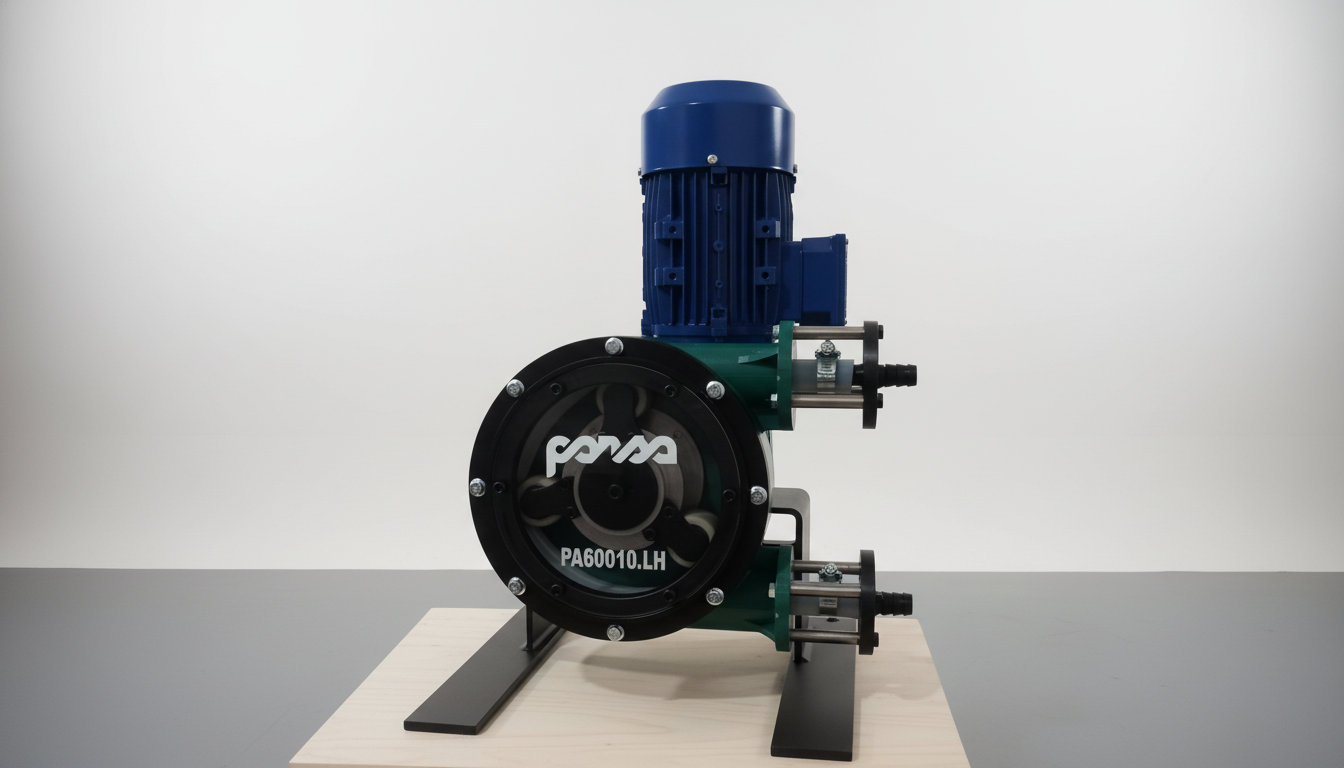
Comprehensive Engineering Guide to Peristaltic Pump Selection
Peristaltic pumps represent one of the most reliable positive displacement technologies available for modern fluid processing. By confining the pumped fluid entirely within a flexible elastomeric tube or hose, these pumps eliminate the need for mechanical shaft seals, packings, and internal check valves. This makes them exceptionally suited for conveying highly abrasive slurries, aggressive chemical reagents, and shear-sensitive biological products. In this manual, we discuss the essential engineering steps required to size and select the optimal peristaltic pump for your process loop.
1. High-Pressure Hose vs. Low-Pressure Roller Mechanisms
The primary architectural distinction in peristaltic pump design lies in how the hose is compressed. High-pressure hose pumps (typically rated up to 16 bar) utilize cast sliding shoes mounted on a heavy-duty rotor. The pump housing is filled with specialized silicone-based lubricant to dissipate frictional heat generated by the shoes sliding over the rubber cover. These units are built for extreme mining slurries and filter press feeding. The sliding shoes apply maximum pressure over a wider contact area of the reinforced hose, ensuring stable flow rates against heavy discharge pipes. Adequate lubrication is crucial here to prevent localized thermal degradation of the outer rubber layer. These heavy-duty configurations are vital for deep mining underflows.
Conversely, low-pressure roller pumps (rated up to 8 bar) utilize rollers with rolling-element bearings. This configuration drastically reduces friction, lowers heat build-up, and maximizes hose life for continuous chemical treatment applications. Because roller-driven rotors roll over the elastomer instead of sliding across it, they generate negligible frictional heat, requiring only a thin coating of lubricating grease rather than filling the entire casing. This makes them highly economical for chemical transfer operations where discharge pressures remain low to moderate. Their clean mechanics reduce the cost of maintenance in chemical facilities.
2. Volumetric Flow Calculations and Rotational Speed (RPM)
Flow in a peristaltic pump is directly proportional to the rotational speed of the rotor. However, to maximize the flex-fatigue life of the elastomer, the pump must be sized to run at conservative speeds. For highly abrasive mining slurries or fluids containing dense solids, the maximum speed should be restricted to 30–50 RPM. Running at higher speeds causes rapid temperature spikes in the rubber wall, leading to delamination of the reinforced textile layers. For clean, non-abrasive fluids, speeds up to 70–80 RPM can be safely tolerated. Lower speeds remain the primary strategy for preserving the hose structure.
Volumetric efficiency is also governed by fluid viscosity. Highly viscous fluids, such as heavy fuel oil, thick polymers, or organic purees, flow slowly. The vacuum created by the restoring force of the hose takes time to pull these fluids into the pump chamber. If the rotor turns too quickly, the hose will be compressed before it has fully filled with fluid. This results in starvation of the pump, cavitation-like behavior, and a significant drop in flow rate. Industrial systems handling viscous media must utilize oversized suction lines and lower RPM settings (below 25 RPM) to ensure complete hose recovery. Piping engineering plays a critical role here.
3. Selecting the Correct Elastomer Compound
Because the hose is the sole wetted component, its material properties dictate the chemical and thermal boundaries of the system. Natural Rubber (NR) offers the highest mechanical resilience and tear resistance, making it the industry standard for mining slurries, thickener underflows, and concrete mixtures. EPDM provides excellent chemical resistance against aggressive acids, alkalis, and oxidizers. Nitrile (NBR) is highly recommended for oil-in-water emulsions, hydrocarbons, and hydrocarbons distillates. Medical-grade Silicone is preferred for pharmaceutical dosing due to its autoclave compatibility and extreme temperature range.
Natural Rubber (NR) has long chain polymer structures that allow it to bend millions of times without cracking. It absorbs impact from sharp solid particles suspended in mining muds. EPDM's saturated polymer chain makes it inert to chemical attack from water treatment additives like sodium hypochlorite. Nitrile (NBR) prevents hydrocarbons from dissolving or swelling the hose matrix, while platinum-cured silicone ensures no leachables enter sterile drug formulations during biotech cell transfers. Material purity remains a top concern for pharmaceutical lines.
4. Occlusion Calibration and Preventive Maintenance
Optimizing hose lifespan requires precise shimming of the compression shoes. Shims are placed behind the shoes to adjust the occlusion thickness. Under-occlusion allows pressurized fluid to slip backwards past the compressed zone, causing localized high-velocity erosion (known as slip-back erosion). Over-occlusion compresses the hose wall unnecessarily, straining the textile reinforcement structure and causing premature structural cracks. Regular monitoring of the casing lubricant, checking for pressure spikes on discharge lines, and setting up leak detection sensors inside the pump housing are key protocols for preventing unscheduled plant downtime.
To implement an effective preventative program, log the exact hours of pump operation and replace the hose before it reaches its estimated fatigue threshold. Installing a liquid leak sensor in the bottom drain of the pump casing provides immediate protection; the moment a hose rupture is detected, the sensor cuts off motor power via the control panel, preventing product loss and protecting the internal rotor assemblies from fluid exposure. Preventive management secures workshop safety.