

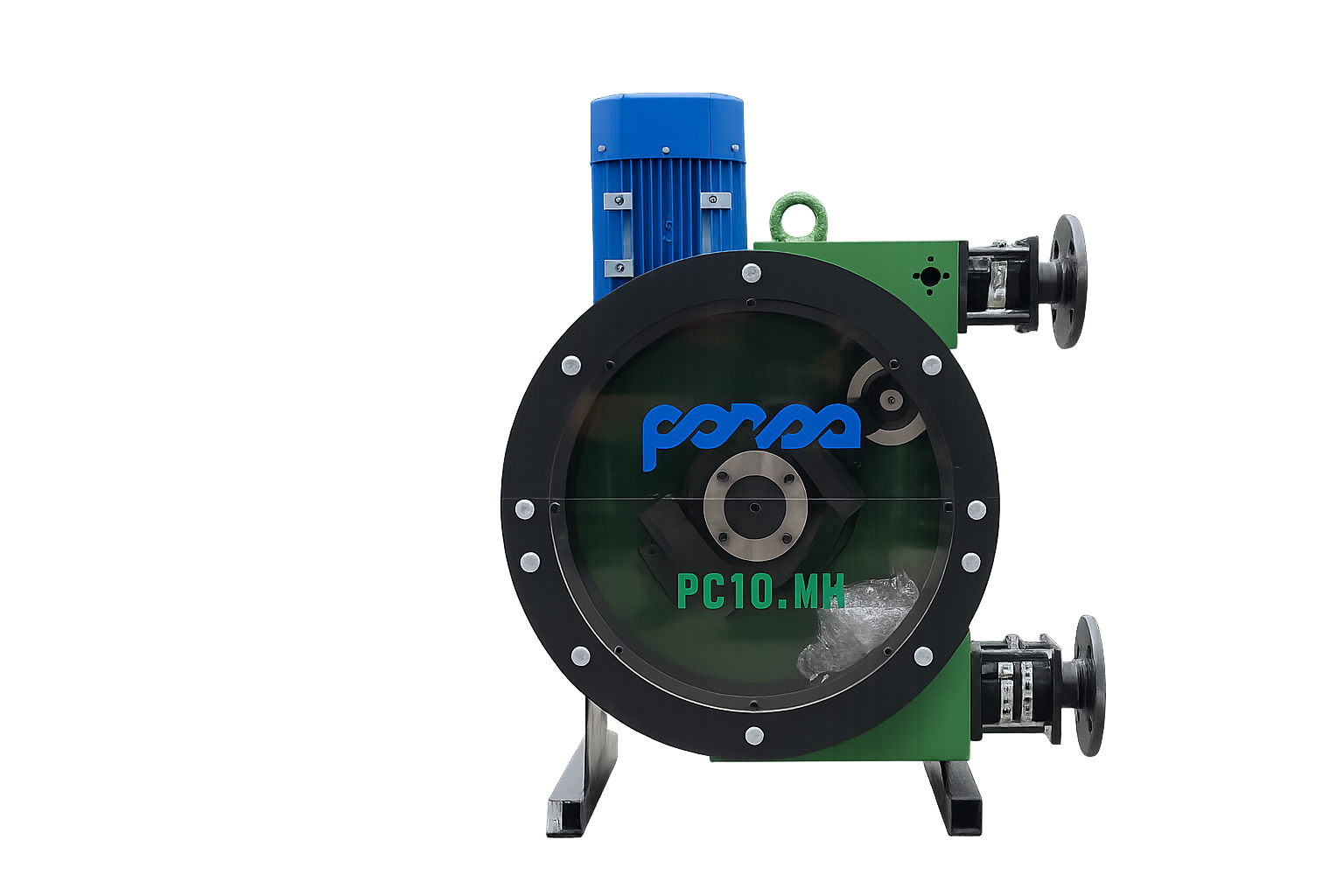
Understanding Peristaltic Roller Pump Mechanics and Occlusion
Peristaltic roller pumps are widely used positive displacement devices in laboratories and chemical plants. Understanding their operation helps engineers optimize flow rates, discharge pressures, and hose lifespan. In this technical article, we analyze the mechanical principles, self-priming vacuum generation, and advantages of Parsa Group's LH-series roller pumps.
1. Rotor Kinematics and Bearing-Driven Rollers
A peristaltic roller pump consists of a central rotor with rollers mounted on its arms. As the motor turns, the rollers press down on the flexible hose inside the casing. Each roller compresses the hose wall, trapping a volume of fluid and pushing it toward the discharge port. This continuous cycle provides a linear flow rate proportional to the motor speed. The rollers must be aligned precisely to avoid uneven compression.
The rollers utilize sealed ball bearings to minimize friction. Instead of sliding shoes that scrape the hose surface, rollers roll over the cover. This reduces mechanical strain and lowers frictional heat generation in the rubber wall by up to 50%, extending the hose's lifespan under continuous operation. The lower operational temperature prevents early vulcanization damage to the rubber outer layer, maintaining its high flexibility over millions of cycles.
2. High Vacuum Generation and Dry Self-Priming
A key capability of roller pumps is dry self-priming. As a roller moves past a compressed section, the hose springs back to its natural shape. This restoration creates a vacuum of up to 9.5 meters of water lift, drawing fluid into the pump chamber without manual priming or foot valves. This vacuum capability is unique to peristaltic positive displacement designs.
This design prevents vapor lock when dosing off-gassing chemicals like sodium hypochlorite. The continuous suction lift makes these pumps ideal for environmental monitoring and water treatment dosing lines. Even if the supply tank runs dry, the pump can run without damage, lifting the chemical the moment the supply is replenished.
3. Thermal Management and Lubricant Requirements
Frictional heat from compression is a primary factor in hose wear. Shoe-driven pumps require the casing to be filled with silicone lubricant to dissipate heat. Roller pumps, due to lower friction, generate minimal heat and only require a thin layer of grease on the hose surface. This simplifies casing setups.
This reduces lubricant costs and simplifies maintenance. Replacing a hose is cleaner since there is no pool of oil inside the pump casing, reducing downtime during changeovers. Clean casing layouts are preferred in sanitary and laboratory environments where oil spills are unacceptable.
4. Occlusion Adjustments and Shimming Protocols
To maintain volumetric efficiency, the rollers must compress the hose correctly. Shims placed behind the rollers adjust the gap. Over-compression increases mechanical wear on the rubber. Under-compression allows backflow (slip), reducing flow rates and eroding the inner hose lining. Proper shimming balances occlusion with wear. Shimming adjustments should be carried out at every hose replacement interval.
5. Conclusion and Applications
Peristaltic roller pumps are efficient for low to medium-pressure dosing (under 8 bar). Parsa Group's LH-series provides low maintenance and reliable flow for chemical, dairy, and water treatment operations, backed by domestic spare parts support. Our service team helps size gearboxes for custom setups.